


Find the right kind of summer.
Compare overnight camps, programs that enroll through partner organizations and a daytime option in Crosslake. Use the map to get oriented, then go to the operator for current dates and enrollment.
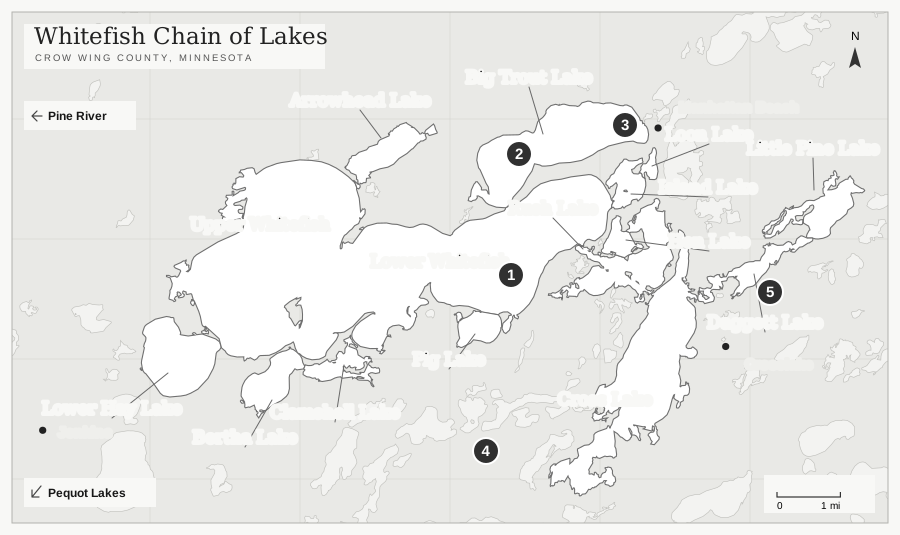
- Camp Foley
Lower Whitefish Lake
- Trout Lake Camps
Big Trout Lake area
- Camp Knutson
Manhattan Point
- Star Lake Out Loud
Star Lake, south of the Chain
- Fun in the Park
Crosslake Community Center
Markers show general areas. Confirm the entrance and arrival instructions for your session with the camp.
Summer camps around the Whitefish Chain
Camp Foley
Coed overnight camp with waterfront activities, sports and creative programs. Compare session lengths and read the parent guide before registering.
9303 Father Foley Drive, Pine River, MN 56474218-543-6161
Trout Lake Camps
Faith-centered summer camps organized by age or grade. Ask which campus and entrance your session uses.
10173 Trout Lake Drive, Pine River, MN 56474218-543-4565
Camp Knutson
Lutheran Social Service of Minnesota hosts camps with partner organizations. Each partner handles camper enrollment for its program.
11148 Manhattan Point Boulevard, Crosslake, MN 56442218-543-4232
Star Lake Out Loud
A camp for LGBTQ+ youth and allies at Star Lake Wilderness Camp. Use the organizer's registration page for current availability.
10992 Star Lake Camp Drive, Pequot Lakes, MN 56472612-642-1775
Fun in the Park
Crosslake Parks and Recreation's daytime summer program. Call the Community Center for current session dates, age groups and registration. The form linked by the city is from 2024.
14126 Daggett Pine Road, Crosslake, MN 56442218-692-4271
Life on the Whitefish Chain
A summer of their own
A first paddle, a cabin full of new friends and a story that takes the whole drive home to tell.

On the drive north, the conversation tends to go back and forth. Who will be in my cabin? Will I get to try sailing? What if I forget something? Then the trees close in around the road and the lake comes into view. Once you have found the right entrance and carried the bags to the right place, there is usually a moment when the grown-ups run out of things to do. That is when a camper gets to start making a summer of their own. Months later, the detail they remember may be a first turn at the tiller or a conversation held well after the rest of the cabin had gone quiet.
Start with the summer your camper wants
Ask your camper to tell you about one day they would like to have. A child who wants to be in the water every chance they get might have different priorities from one who would happily spend the afternoon making something with a small group. Some want a busy schedule and a chance to try several activities. Others like knowing what comes next and seeing the same group at meals. Ask how activities are chosen, how long campers spend in each one, and what happens when conditions keep everyone off the water. Those answers tell you more about daily life than a long list of activities.
Look at the length of the session, too. A first overnight stay and a longer stretch away from home ask different things of a family. Camp Foley offers an overnight setting on Lower Whitefish Lake, with a parent guide and information about activities, dates and rates. Read the guide together and let your camper ask the camp a question they came up with themselves. A small conversation before the trip can make the person at the other end of the line feel a little more familiar on arrival day.
Read the program as closely as the packing list
Trout Lake Camps organizes its faith-centered programs by age or grade. Start with the page for your camper's group and ask where that session meets. If siblings attend different programs, check each arrival window and entrance before you make a single travel plan. It is also worth asking how the faith component fits into an ordinary day, how groups are organized and which activities campers choose. You may find that the daily schedule helps your family decide more quickly than the photographs do.
At Camp Knutson, start with the partner organization for the program you are considering. Ask who enrolls campers, who you should call about individual support and who will be your contact after drop-off. Star Lake Out Loud has its own registration process even though the venue is Star Lake Wilderness Camp. Use the organizer's instructions for dates and arrival. In both cases, the person who runs the program can answer questions that a general venue listing cannot. Have any conversations about health, dietary needs or accommodations privately with the camp's designated staff.
If you will already be in Crosslake for part of the summer, check Fun in the Park through the city's Parks and Recreation department. A daytime program has a different rhythm. You can fit it around an existing stay and still have supper together afterward. Check what dates the city offers, whether the age range fits your camper and how daily drop-off and pickup work before you arrange the rest of the week.

Compare what is included before you choose
Put the sessions you are considering next to one another on the calendar. Write down the arrival and departure days, the program fee, the deposit deadline and any optional charges the camp lists. Ask whether things like equipment, laundry or a camp store account need a separate payment. If the date is the only thing holding you back, ask how the waitlist works and what happens if you have to change sessions. That is also a good time to ask the office about payment plans or scholarships if cost will affect your decision.
Then take another look at what the week will feel like. Ask how campers are grouped, who supervises waterfront activities and what the camp does if a child wants to sit one out. A child who is excited about sailing may still want to know how beginners get started. Another may want a quiet place to read or a chance to tell someone when the day feels too full. Ask the staff for an example from an ordinary day. It is easier to picture the experience when you know how the camp handles familiar moments as well as the big ones.
Pick one thing to do at home before leaving. It could be helping your camper mark their gear, letting them pack the bag in the order they want it, or practicing how they will keep wet clothes separate on the way home. Keep the camp's instructions handy and ask before buying equipment you may only use once. A little practice with a familiar task gives your camper something they already know how to do when most of the day feels new.
Leave room in the arrival day
Get directions from the camp shortly before you leave, particularly if there are several entrances or a special check-in location. Let the map get you into the area, then follow the operator's arrival instructions. A little extra time helps when you need to make a stop, find the right driveway or wait your turn to unload. Keep the paperwork together and put anything the staff asks to see on arrival where you can reach it without unpacking the car.
Talk about the first evening before the trip. Ask how the camp introduces cabin groups, what a camper should do if they cannot find something and how families will hear from staff. Let your camper know whom to ask for help. Some camps limit phones or have their own system for messages. Knowing that ahead of time makes it easier to agree on what to expect, both for the camper and for whoever will be waiting to hear how it went. Follow the camp's packing instructions so you know what is provided and what needs to come from home.
Give the rest of the family a day of its own
If you are staying nearby, choose something simple after drop-off. In Crosslake, a walk at the recreation area or lunch in town gives everyone time to get their bearings. The Parks & Trails guide can help you pick an outing that fits the time you have. If the weather turns, give yourself a shorter option and leave a little space in the plan for a meal. You can spend a good afternoon here without trying to visit every lake or town in one trip.
For pickup, make the camp's departure window the fixed point. Choose lodging and travel plans around it, especially if another household is sharing the drive. If you have time afterward, let your camper choose the next stop. For one child, it may be the first meal they have talked about all week. For another, it might be a quiet hour before they want to answer questions. Our dining guide includes places to eat in town and takeout for the road or the cabin.
Ask about one moment on the way home
It is tempting to ask for the whole story at once. Start with one thing instead. What did you do when it rained? Who made you laugh? Was there something you did that you did not think you could do? Sometimes the answer comes right away, and sometimes you hear it at breakfast three days later. When you do, you get a glimpse of the place through their eyes. If they want to go back, write down what they liked while it is still fresh. That will help when you look at dates again and talk about what they might like to try next summer.
Before putting the gear away, ask which things came home untouched and which they wished they had brought. Those are small details, but they are part of learning how to get ready for the next trip. You may remember the drive and the line at check-in. They may remember the sound of paddles coming out of the water, or the walk back to the cabin with someone they already hope to see again.


