


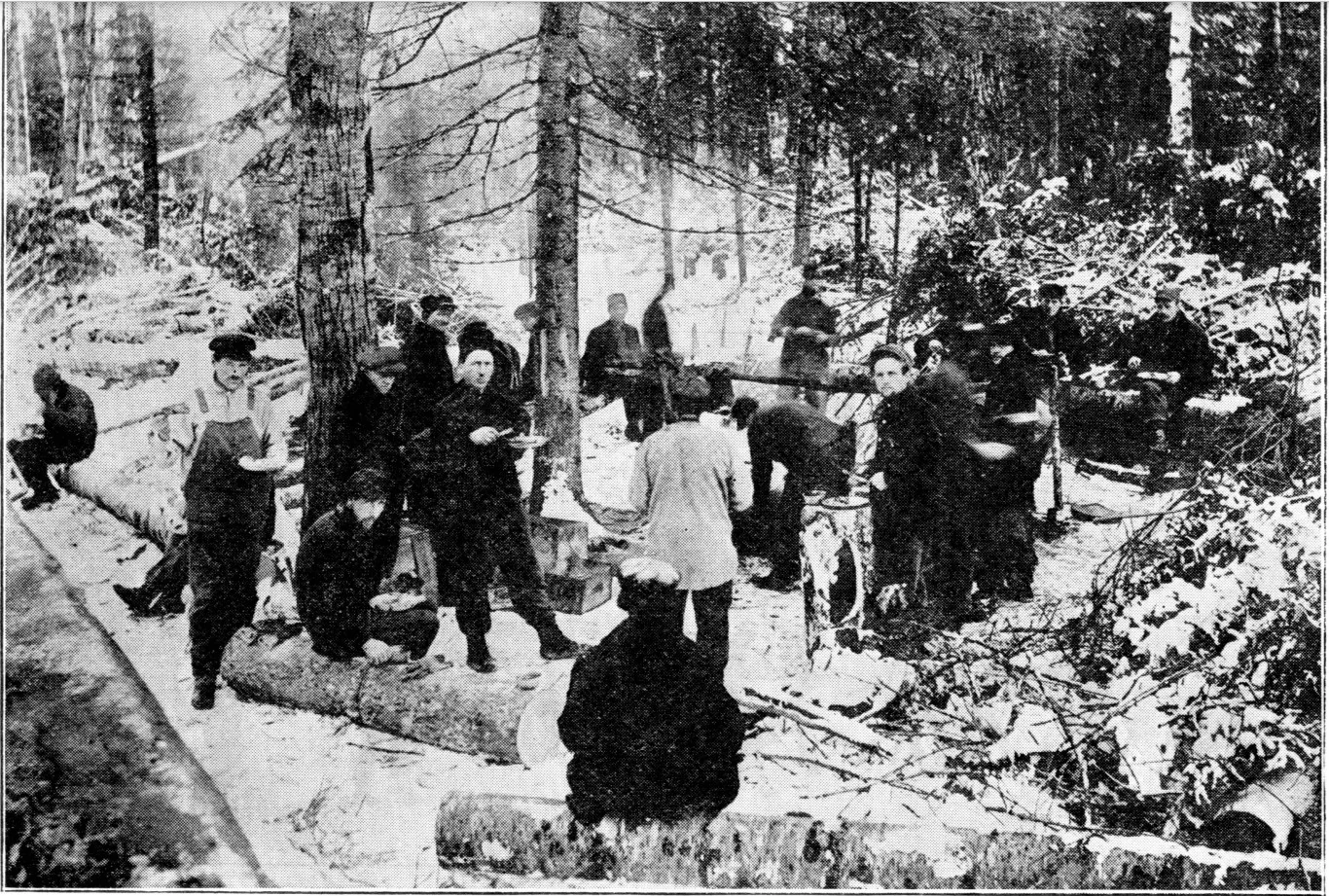
A railroad once reached Cross Lake without joining any other railroad. Its freight had a way forward all the same. Timber brought in from the pineries went into the water for the next leg of a journey that depended as much on the river as it did on the rails.

Horses and log booms on Whitefish Lake
Archaeologist Douglas A. Birk describes horse-powered headworks used on the Whitefish lakes: horses turned a winch on a raft, pulling the raft and an enclosed collection of logs toward an anchor placed ahead. The anchor was repositioned and the process repeated. A steam barge entered service in the late 1880s, carrying supplies and sometimes towing logs.
Birk's Institute for Minnesota Archaeology study dates the isolated Cross Lake railroad's beginning to 1890 and a purchase by Frederick Weyerhaeuser and associates to 1893. It describes supplies arriving across the Chain from Jenkins, while logs headed from the railway into Cross Lake and onward toward Mississippi River mills.
The practical question was how to move material through each particular stretch of country. Looking for one invention to explain the whole journey misses the connections between the different stages.
What happened when the river backed up?
An account in the Brainerd Dispatch on August 30, 1895, preserved in the Crow Wing County Historical Society's newspaper transcriptions, reports the arrival of the last Cross Lake and Pine River logs in the Mississippi. It describes track repairs for the next winter's hauling and explains that the Pine River drive had been held back while another jam was worked through at Brainerd.
It is a report about work waiting on other work. That ordinary detail connects the lakes to a much larger industrial landscape: a delay downstream could affect the movement of timber from far upstream. Looking at Cross Lake alone would miss that relationship.
The newspaper also reported plans to clear logs from the Brainerd dam so repairs could proceed. The river had to serve transportation and maintenance schedules at the same time. That gives the phrase "log drive" a more concrete meaning than a picturesque image of timber floating away.
Was the dam built just for logging?
The federal project had a broader purpose. The Army Corps of Engineers explains that the Mississippi Headwaters reservoirs supported navigation by storing water for release downstream. Pine River Dam began operating in 1886. Later navigation improvements reduced the need for that supplemental flow, and recreation became an increasingly important part of the reservoirs' role. The Corps' Headwaters history is a useful companion to the logging story.
The managed water helped move timber, while the federal project served navigation farther down the Mississippi. The logging companies used a system whose purposes extended well beyond the Chain.
A railway remembered in the archives
The Minnesota Historical Society catalogs a Northern Pacific presidential file titled "Northern Mississippi Railway: Cross Lake Logging Railway, 1903-1910," numbered 998. Its collection finding aid points researchers toward surviving business records.
For a visitor, start with the broader Whitefish Chain history and the Pine River Dam area. The next time you look across the water, imagine a journey measured in anchors, loaded railcars and downstream delays. The vacation landscape has a working history beneath it.
More Whitefish Chain stories
Names & Folklore
People & Places
Resorts & Summer Camps
- Manhattan Beach Lodge and Big Trout Lake Resort History
- Whitefish Chain Family Resorts: The Cabins That Survived
- Camp Foley's Stone Chapel on Lower Whitefish Lake
- Camp Knutson History: A Whitefish Chain Summer Camp
- Boyd Lodge History: From Fishing Cabins to Family Resort
- Whitefish Lake Resorts in 1924: A Railway-Era Vacation
- The Log Home Inside a Towering Pines Resort Cabin