


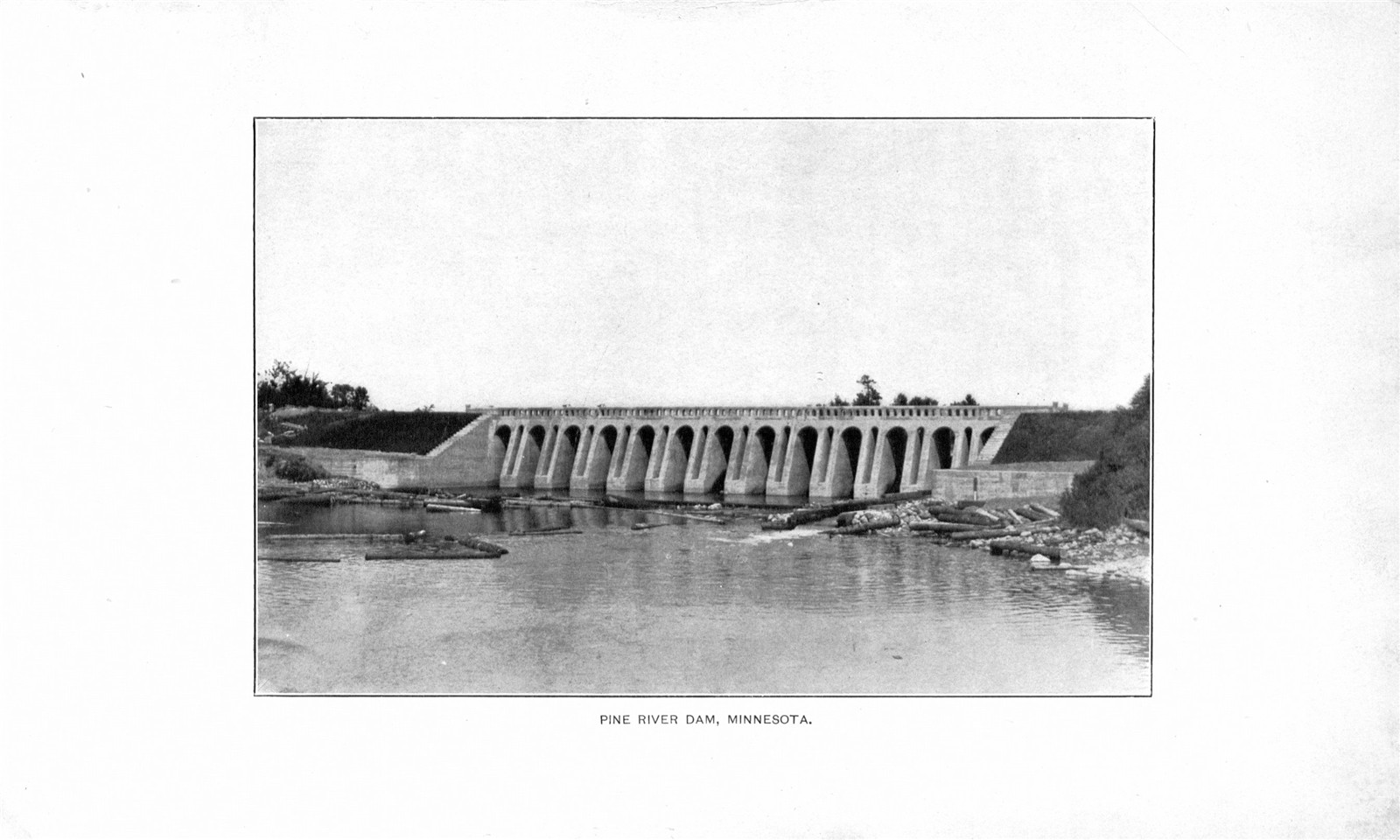
From the bank, the Pine River Dam is a row of concrete arches. Below, the control structure rests on timber piles from the earlier dam. Federal plans and photographs also show a working settlement close by, with shops and living quarters that are gone today.
Why did engineers start with timber?
The federal history of the Mississippi River Headwaters Reservoirs explains that transporting construction materials to remote sites was difficult. Timber was available locally, even though masonry was already standard Corps engineering. The plan anticipated replacing the timber structures later.
That changes the way the early dam can be understood. Building in wood was a practical response to the setting. A construction project had to work with the roads, equipment and supplies it could actually obtain.
Machinery moved from one headwaters dam project to the next. Crews at Pine River had equipment and experience from the earlier sites to draw on as they set to work at Cross Lake.
What changed when concrete arrived?
The Pine River Dam's individual engineering history dates its concrete reconstruction to 1905-1907. It records the reuse of the original timber piles beneath the replacement control structure. It also identifies a fishway added in 1912 and a later apron replacement in 1950.
In this historical snapshot, "the dam" was not one finished object with one construction date. Different parts belonged to different projects, and a substantial rebuilding still incorporated earlier work.
The working village beside the dam
The Pine River report describes 17 buildings erected for the original project in 1884. The complex included living quarters, a dining hall, workshops, a warehouse, a sawmill and even a chicken coop. Later residences were lost to fires in 1921 and 1959. By the time of the historical survey, recreation development had left no visible evidence of those structures.
Imagine reading an old site plan with that list in mind. A workshop suggests repairs. A dining hall suggests people needing meals. A home suggests life continuing after the construction crews left. Together, those buildings turn the dam site into a place where people worked, ate and lived.
The broader Headwaters report adds another everyday detail: a telephone system connecting dam sites and the St. Paul office was completed in 1905, replacing earlier telegraph reporting. Communication was part of the infrastructure too.
A different way to visit Crosslake
Use our Cross Lake Recreation Area guide for present-day visitor planning and the Whitefish Chain history guide for the larger timeline. The archival reports offer a different kind of preparation: a way to notice the gap between the landscape you can see and the work that made it.
The most interesting question may be less "How old is the dam?" than "Which part of its history am I looking at?"
More Whitefish Chain stories
Names & Folklore
People & Places
Resorts & Summer Camps
- Manhattan Beach Lodge and Big Trout Lake Resort History
- Whitefish Chain Family Resorts: The Cabins That Survived
- Camp Foley's Stone Chapel on Lower Whitefish Lake
- Camp Knutson History: A Whitefish Chain Summer Camp
- Boyd Lodge History: From Fishing Cabins to Family Resort
- Whitefish Lake Resorts in 1924: A Railway-Era Vacation
- The Log Home Inside a Towering Pines Resort Cabin